

Joseph Lau
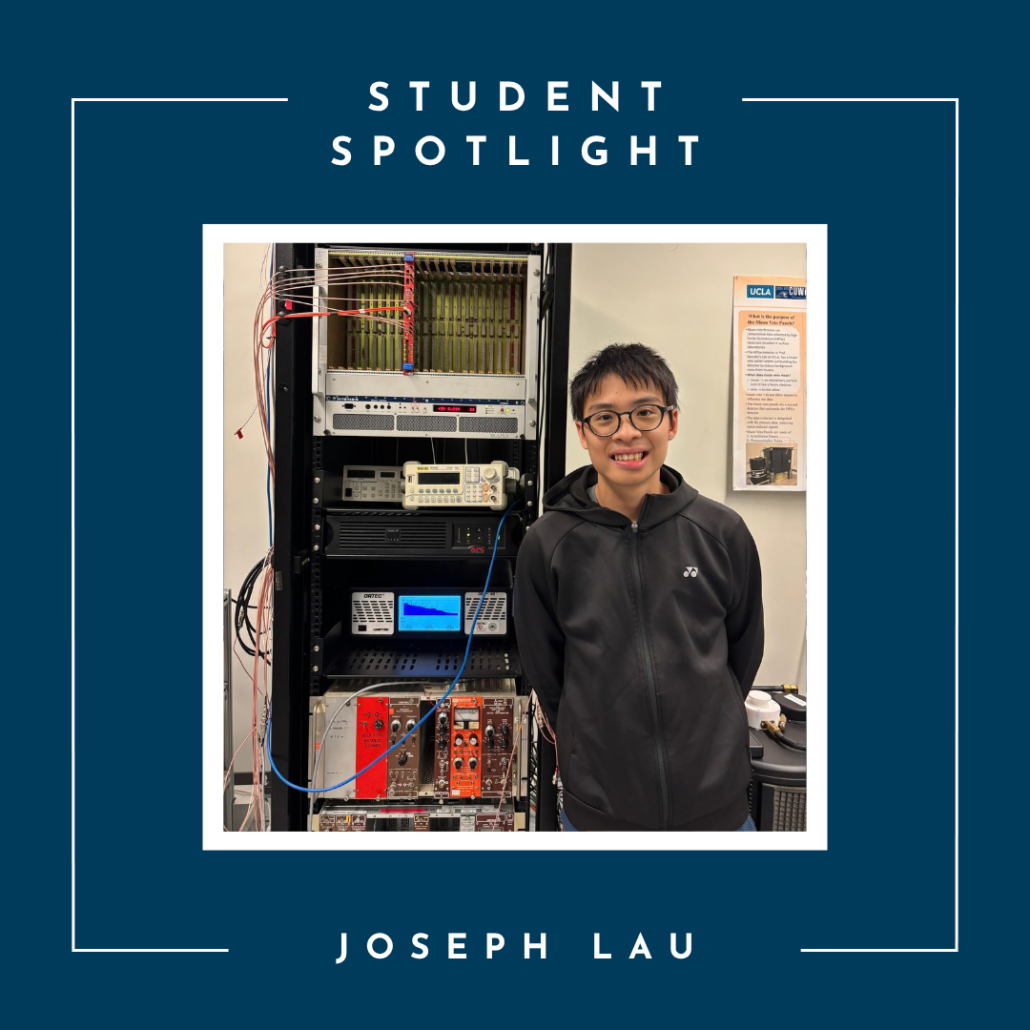
STUDENT SPOTLIGHT
Meet Joseph Lau! Joseph is a fourth-year physics major looking to pursue a Physics PhD in theoretical physics and continuing physics research in academia. Joseph has presented in over five physics conferences and will be published soon as first-author on a paper about the feasibility of neutrino communication. As a 2026 URFP scholar, Joseph was able to learn a lot about the details of academia, such as writing formal academic documents, alongside optimizing profiles as upcoming scientists. Read Joseph’s full interview below!
1. What is your year and major?
I’m a senior physics major!
2. How did you first get involved in your research project? Tell us a bit about the lab you are in and the research you are conducting!
For my research in UCLA’s Kamaha Lab, which investigates dark matter, one of physics’ biggest unresolved mysteries, I cold-emailed the lab’s professor directly. I was very motivated to work in this field, and did substantial background research to try to learn as much as possible before the first meeting, which I felt was very important as being prepared is always the best thing. Currently, I’m doing multiple research topics in addition to my dark matter lab, which includes neutrino communication and theoretical quantum gravity (holography and black hole evaporation). For my research in the Kamaha Lab, I work on the Noble Element Simulation Technique (NEST), which is the global framework for dark matter interaction simulations, and I specifically work on detector microphysics and building a most optimal electronic recoil model, which dark matter experiments heavily rely upon.
3. How would you describe your research experience at UCLA?
My research experience here at UCLA has been so fruitful as I’ve had the wonderful opportunity of researching many different aspects of high-energy particle physics, including both experimental and high-energy theoretical physics. All the professors I’ve worked with have been really supportive and imparted lots of valuable advice, providing me with plenty of opportunities to showcase my research. I definitely think research is one of the best experiences an undergraduate could have, and it really opens up yourself to so many new possibilities.
4. What is one piece of advice you have for other students thinking about getting involved in research?
Try to search for what drives you most, what captivates your curiosity the greatest. It should be something where putting the work in feels fun and enjoyable to you! Always have an open mind as well, be proactive in exploring different topics in your own time to get a stronger grasp of the field, as constantly persisting to build up your knowledge is an invaluable skill in research. Plus, you’ll gain much more perspectives. Conducting the actual research on a daily basis is very different from just enjoying reading about a subject, so don’t be afraid to dive deep in the literature.
5. Have you attended a conference before? If so, can you describe your experience on preparation, presenting, etc.?
Yes, I’ve presented now at more than 5 physics conferences, and every single one of them is so unique in their own way. Preparing for them requires quite a lot of work, and a lot of it includes condensing information to make sure that I can convey my research outcomes effectively. When the time for presenting comes, confidence is key knowing all the work that I’ve put in, so the
presentation actually becomes one of the most pleasant parts. The conversations have always been most memorable, and I’m very glad to have connected with prominent physicists and directors of top physics institutes at different conferences. It’s also very fun to travel around the country as part of the conference experience with your friends and fellow physicists, and it is definitely one of the most eye-opening aspects of my undergraduate journey.
6. Have you had your work published? Can you talk about what that process was like?
My first-author paper on the feasibility of neutrino communication is about to be published very soon, which I’m so looking forward to! Writing a scientific paper, especially a first-author one, takes a long time, and it’s so crucial to go through all the in-depth details line by line rigorously many times to cross-check your work, and put all your thoughts and ideas into logical, coherent prose where people can understand your approach. Drafting and noting down all different ideas during the entire research process from the beginning was also really helpful in organizing the entire paper later on, and reinforcing my arguments. Finding and tackling gaps in the literature was the main motivation and cause for my paper, so it’s extremely important to have a solid fundamental understanding of the topic, and read paper after paper to familiarize yourself even more with the topic. Collaborating with my professor was most essential to formulating the paper, so always reach out and engage as much as possible in discussions!
7. What are your future career goals?
My future career goal would be to pursue a Physics PhD in theoretical physics, and continuing physics research in academia. It is such an exciting time in physics, since technology is rapidly improving, and there are so many unresolved open problems in physics with endless possibilities, and I love the satisfaction of getting to the final solution after detailed lengthy coding or dense pen and paper mathematical derivations. I’m most interested in theoretical particle physics, as it is the most fundamental first-principles framework to understanding the Universe, and the underlying mathematics is just so mindblowingly elegant. I have a lot of ideas theoretically and computationally, and always push myself to go above and beyond, so theoretical physics is definitely the most suitable field for me to demonstrate my abilities.
8. Please list any URC/departmental programs you are/were involved in. How has your experience been in these programs?
I was a URFP scholar in 2026, and I absolutely loved being part of it! The weekly seminar discussions and presentations were very rewarding, containing valuable resources for everything you need as a student researcher, application processes for further studies, especially getting to know my fellow undergraduate science researchers from different backgrounds in STEM, a rare unique opportunity which I highly cherish. It was fun learning a lot about the details of academia, writing formal academic documents such as abstracts and proposals, alongside optimizing our profiles as upcoming scientists. I highly recommend applying to URC programs if you are interested in conducting research at UCLA!
9. What was the impact of undergraduate research on your career path?
Research is undoubtedly the most significant component of academia and climbing up the ladder in the scientific field, so I feel its tremendous impact in so many ways. Coursework and attending events can only go so far, but working day to day on cutting-edge literature gaps in physics is most consequential in determining my niche, and what I can contribute most towards. The feeling of working on a problem where there’s no known answer is extremely special, and it further strengthened the drive in me to excel in physics research.