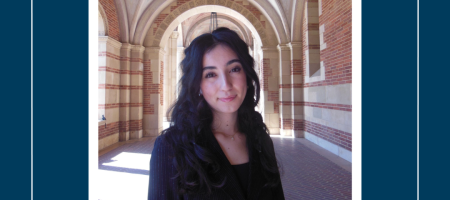
STUDENT SPOTLIGHT
Meet Alexa Garcia! Alexa is a fourth-year Molecular, Cellular, and Developmental Biology major who wishes to pursue an MD degree and continue research in medical school and beyond. She is currently involved in the Undergraduate Research Scholars Program (URSP), a three-quarter scholarship program that supports students who are conducting a life science, physical science, or engineering research project with a UCLA faculty member. Alexa is currently conducting research in the Lipshutz Lab, where the primary research focus includes finding genetic therapies for metabolic disorders in the brain and liver in children.
1. How did you first get involved in your research project? Tell us a bit about the lab you are in and the research you are conducting (if possible)!
During my Freshman and Sophomore years, I had been involved in PEERS, the Program for Excellence in Education and Research in the Sciences. The PEERS program introduced me to BISEP (Biomedical Sciences Enrichment Program), which was met to teach and introduce us into basic laboratory skills as well as how to analyze papers. At the end of our program, we had the opportunity to interview with multiple labs in a mini interview format. I interviewed with Dr. Gerald Lipshutz and was very intrigued by the work his lab did, and so I contacted him and soon joined the lab!
In the Lipshutz Lab, the primary research focus includes finding genetic therapies for metabolic disorders in the brain and liver in children. I currently am researching an AAV gene therapy for SLC6A8 transporter protein deficiency in murine models. In the past, I have done research pertaining to a gene therapy for CPS1 deficiency, a hepatic enzyme. We primarily conduct wet lab assays such as Western blots, PCR, RT-qPCR, creatine assays, and immunohistochemistry staining.
2. How would you describe your research experience at UCLA?
My research experience at UCLA has been an extremely educational and valuable experience. I remember entering UCLA and knowing I wanted to get involved in research, but was never sure about the path I needed to take. Research has given me opportunities to apply the abstract concepts and experiments that I have learned about to real, scientific hypotheses. UCLA had also provided an environment that supports research at every avenue and truly gave me an opportunity to learn it from the very beginning. I began with learning PCR and assisting around the lab, before I received all of the required trainings. I then was able to learn and conduct assays of my own and assist with the SLC6A8 project.
3. What is your year and major?
I am entering my fourth year and my major is Molecular, Cellular, and Developmental Biology.
4. What is one piece of advice you have for other students thinking about getting involved in research?
I advise others who are interested in research to look at department faculty websites and search for faculty that conduct research you may be interested in! It is always valuable to reach out and provide your information as they may be accepting undergraduate students in their lab. Even if you are not sure, reaching out and inquiring about their lab is a great step as it puts you out there and allows you to have discussions with labs.
5. What are your future career goals?
In the future, I wish to pursue an MD degree as well as continue research in medical school and beyond. I hope to practice in pediatrics and pursue research avenues catered towards clinical therapies for cerebral metabolic disorders.
6. Please list any URC/departmental programs you are/were involved in. How has your experience been in these programs?
I was first involved with the PEERS, Program for Excellence in Education and Research, during my Freshman and Sophomore years. Through this program, I received the CARE Fellows scholarship. I also was in the URSP, Undergraduate Research Scholars Program, during my Junior year and will also be in URSP for my Senior year.
7. What was the impact of undergraduate research on your career path?
My undergraduate research experience at UCLA has greatly influenced my career path. Research has taught me how to critically think and also understand different methods for achieving a specific hypotheses. It has given me valuable skills in conducting experiments and assays that are the basis for understanding clinical applications. While I do not do clinical research, it is fulfilling to know that someday these genetic treatments can be applied clinically. This has become a great source of inspiration when beginning research.