
Christian Aguirre
STUDENT SPOTLIGHT
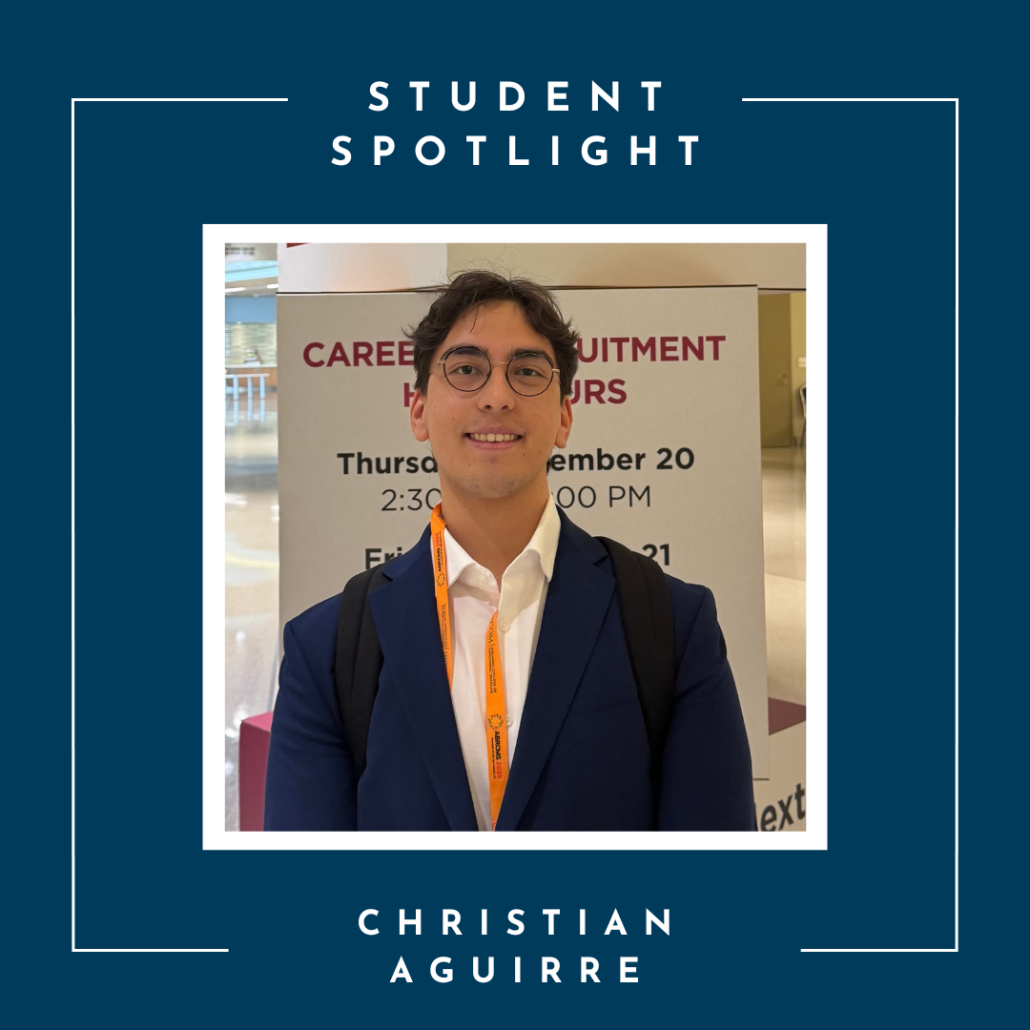
Meet Christian Aguirre! Christian is a fourth-year MIMG major, and recently presented at the ABRCMS Conference, hosted by the American Society for Microbiology. As of Fall 2025, Christian was accepted into the Undergraduate Research Fellows Program (URSP), a three-quarter scholarship program that supports students who are conducting a life science, physical science, or engineering research project with a UCLA faculty. Christian hopes to become a physician-scientist in the future and credits undergraduate research for strengthening his desire to pursue this career.
1. How did you first get involved in your research project?
Tell us a bit about the lab you are in and the research you are conducting (if possible)! I transferred to UCLA from community college without any research experience. I started cold-emailing faculty to find research opportunities on campus. I eventually interviewed with the Pernas lab after reading about their research focus: host–pathogen interactions and metabolism during infection by the intracellular protozoan parasite Toxoplasma gondii . I joined the lab in October 2024 and started to learn relevant lab skills from the get-go. I conveyed interest in pursuing an independent research project to my mentor. This led me to pursuing MIMG Path 2, the major’s advanced independent research capstone project. My research project focuses on how the protein glutathione peroxidase 4 (GPX4) affects parasite growth. GPX4 is a key protein for protecting our cells from the accumulation of lipid peroxides, a potentially harmful lipid species that can lead to a form of non-apoptotic cell death known as ferroptosis. However, the role of GPX4 in T. gondii growth remains unclear. My work fits into a much larger project under my mentor, which further explores the role of lipids in T. gondii infection.
2. How would you describe your research experience at UCLA?
Enriching, fun, and a once-in-a-lifetime opportunity! I knew I loved science and being in a non–research lab environment from my lab classes, but I was unsure how I would like research itself. Now, I can say that my research experience at UCLA over the past year has been one of the most rewarding experiences in terms of the supplemental opportunities I have been able to pursue. Our lab is definitely a family environment and very supportive of one another, and I’m beyond grateful to be part of it!
3. What is your year and major?
I am a fourth year microbiology, immunology, and molecular genetics major.
4. What is one piece of advice you have for other students thinking about getting involved in research?
Be confident in yourself. It sounds cliché, but, speaking from experience, it’s very easy to feel the effects of imposter syndrome. When starting, you might feel like you need to know everything about the science that your lab is investigating. The truth is that you aren’t expected to. From what I’ve learned, research is an environment of academic growth and personal development, especially during your undergrad. As long as you are confident in your abilities and show interest in your work, you’ll do great!
5. How was your experience presenting at the American Society for Microbiology’s conference? Feel free to walk us through your preparation, day to day at the conference, things you’ve learned, etc.
It was amazing! I’ve attended conferences before, but not as a presenter. This time around, I had the opportunity to present my project in the form of an oral presentation. The ABRCMS conference, hosted by the American Society for Microbiology, was definitely a great step into scientific presentation. The environment was incredibly supportive and developmental for undergraduate students, post-baccalaureate, and graduate students alike – I felt very welcomed during my participation. In preparation for the conference, I practiced my presentation with my lab for their feedback, met with my mentor to polish my slides, and read publications to prepare myself for potential questions. At the conference, you are given a comprehensive itinerary in which you can choose what events to attend (some events overlap, so you are encouraged to network with others to get the most out of the conference!). I attended panel discussions related to post-baccalaureate programs, navigating the current scientific landscape, expert lectures on several biomedical research fields, how to prepare for an MD/PhD, student poster and oral presentations, and a career development and recruitment hall (where you can meet program representatives to ask questions and network with them). Overall, I learned a lot about the options that are available after completing your undergraduate degree, received so much advice from experienced scientists, and made tons of connections!
6. What are your future career goals?
I would like to pursue the journey of becoming a physician-scientist. I enjoy the lab environment and research so much, as well as the direct patient interaction that comes from working in healthcare – I cannot see myself pursuing a career that does not cohesively bridge the realms of scientific research and patient care.
7. Please list any URC/departmental programs you are/were involved in. How has your experience been in these programs?
In the spring of 2025, I was accepted into the MIMG Path 2 (Advanced Independent Research) program, in which I continued my research project that I had started under an SRP 199 contract. Then, in the fall of 2025, I was accepted into the URC Undergraduate Research Scholars Program. These opportunities have been developmental in terms of my experience in and exposure to the vast world of scientific research. Having the opportunity to continue my research with additional funding and grow my scientific knowledge and communication skills as a researcher has been one of the most fulfilling experiences of my academic and professional journey thus far. I believe that both of these programs have prepared me for my next steps forward in science.
8. What was the impact of undergraduate research on your career path?
I knew that I wanted to pursue a career in the medical field and had considered the physician-scientist path. Undergraduate research has only strengthened my desire to follow this career and has given me better insight into my research interests and strengths.