
Ryu Adams
STUDENT SPOTLIGHT
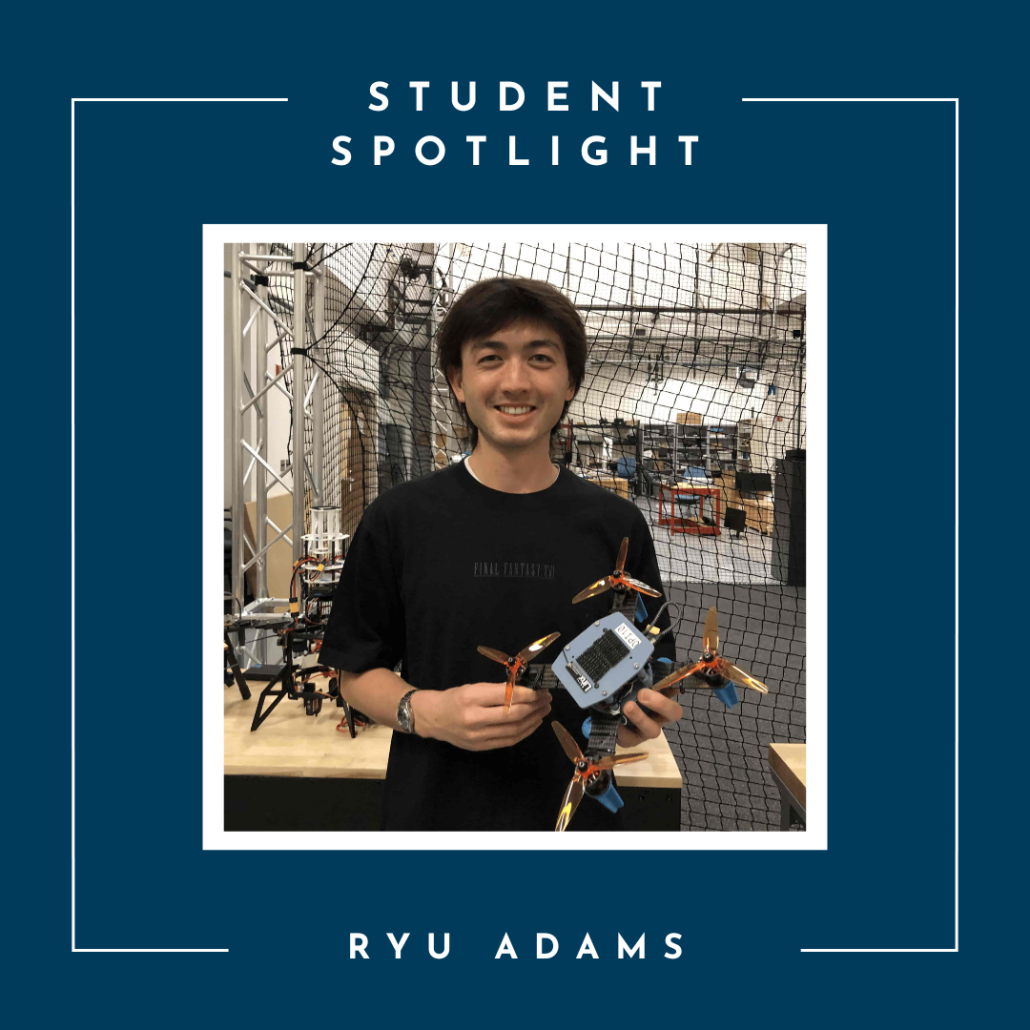
Meet Ryu Adams! Ryu is a third-year Computer Science major and is working towards pursuing a PhD in robotics. He is currently a UC LEADS scholar and recently attended the UC LEADS annual symposium at University of California, San Francisco. Ryu credits undergraduate research in helping him “find a direction to take [his] career that could serve as an outlet for [his] interests.” Read Ryu’s full interview below.
1. What is your year and major?
I am a Junior, Computer Science major.
2. Please list any URC/departmental programs you are/were involved in. How has your experience been in these programs?
I am a UC LEADS scholar. The program has been an amazing experience in so many aspects. Because of UC LEADS I have been able to not only continue research in robotics with amazing mentors at UCLA and UC Berkeley, but also the opportunity to present my work at the annual symposium and make valuable connections with industry experts, graduate students, and fellow undergraduate researchers. The program takes students from all disciplines of science, which has broadened my knowledge in research beyond robotics, and opened my eyes to interdisciplinary research ideas. The UC LEADS program has been a cornerstone in shaping my undergraduate research experience.
3. How did you first get involved in your research project? Tell us a bit about the lab you are in and the research you are conducting!
After my first summer at Oregon State University where I got to work on autonomous underwater robots, I was interested in continuing robotics research back at UCLA. I found the Verifiable and Control-Theoretic Robotics (VECTR) Lab postering at the URP Research Fair and after an exchange of emails I joined the team Fall of my sophomore year. At VECTR, I work on motion planning and control of agile autonomous robots (e.g. drones). My current project is focused on building a machine learning model that can generate trajectories as expressive and accurate as traditional time-optimal trajectories, but with the real-time efficiency required for agile flight. With my research I hope to advance safety and autonomy for robots deployed in urban environments (e.g. delivery robots).
4. How would you describe your research experience at UCLA?
My research experience at UCLA has had a major impact on my goals for the future. I entered UCLA as a Cognitive Science major and an eagerness to learn about artificial intelligence. Through my research experiences however, I discovered the excitement of developing software that makes robots move and act in the real world. My undergraduate research experience has given me a clearer trajectory of my career after graduation and made me more confident that a Ph.D. is the right path for me.
6. Have you attended a conference before? If so, can you describe your experience on preparation, presenting, etc.?
I recently attended the UC LEADS Annual symposium at UC San Francisco. For the event, I prepared a poster and presented it to a panel of judges in the field of robotics and controls research. It was a great experience and I had a very easy time preparing for the event, as I was just reformatting what I work on in the lab to a poster and describing my work, which I already do all the time to my lab mates and family. I was also able to meet industry professionals and graduate students in the field, which led to many great conversations. One of my judges in particular was an autonomous drive engineer at Tesla with whom I had a great conversation with after my presentation, and even gave me a tour of his engineer’s car, a modified Tesla with the backend technology exposed for testing purposes. Overall, the symposium was a pivotal experience that validated my work and expanded my professional network.
6. What is one piece of advice you have for other students thinking about getting involved in research?
Don’t be afraid to reach out and make connections with professors and graduate students. During my first year at UCLA, I felt intimidated by experts and feared I was too inexperienced to contribute. I soon realized that researchers are often eager to share their passion with anyone who shows genuine interest. In my experience, an eagerness to learn often outweighs a lack of prior knowledge. My advice for all students interested in research: send those cold emails! You’ll be surprised how many doors they can open.
7. What are your future career goals?
I plan on pursuing a Ph.D. in robotics. In the future I wish to work in the robotics industry as a research scientist, developing robots that can safely and efficiently coexist with humans.
8. What was the impact of undergraduate research on your career path?
While I had been interested in robotics and artificial intelligence since high school, undergraduate research really helped me find a direction to take my career that could serve as an outlet for my interests. I feel lucky that public interest in robotics and AI has grown so much and my research is becoming a relevant part of modern society. Through undergraduate research I feel that I’ve set myself up for making a real, positive impact in the field of robotics.