

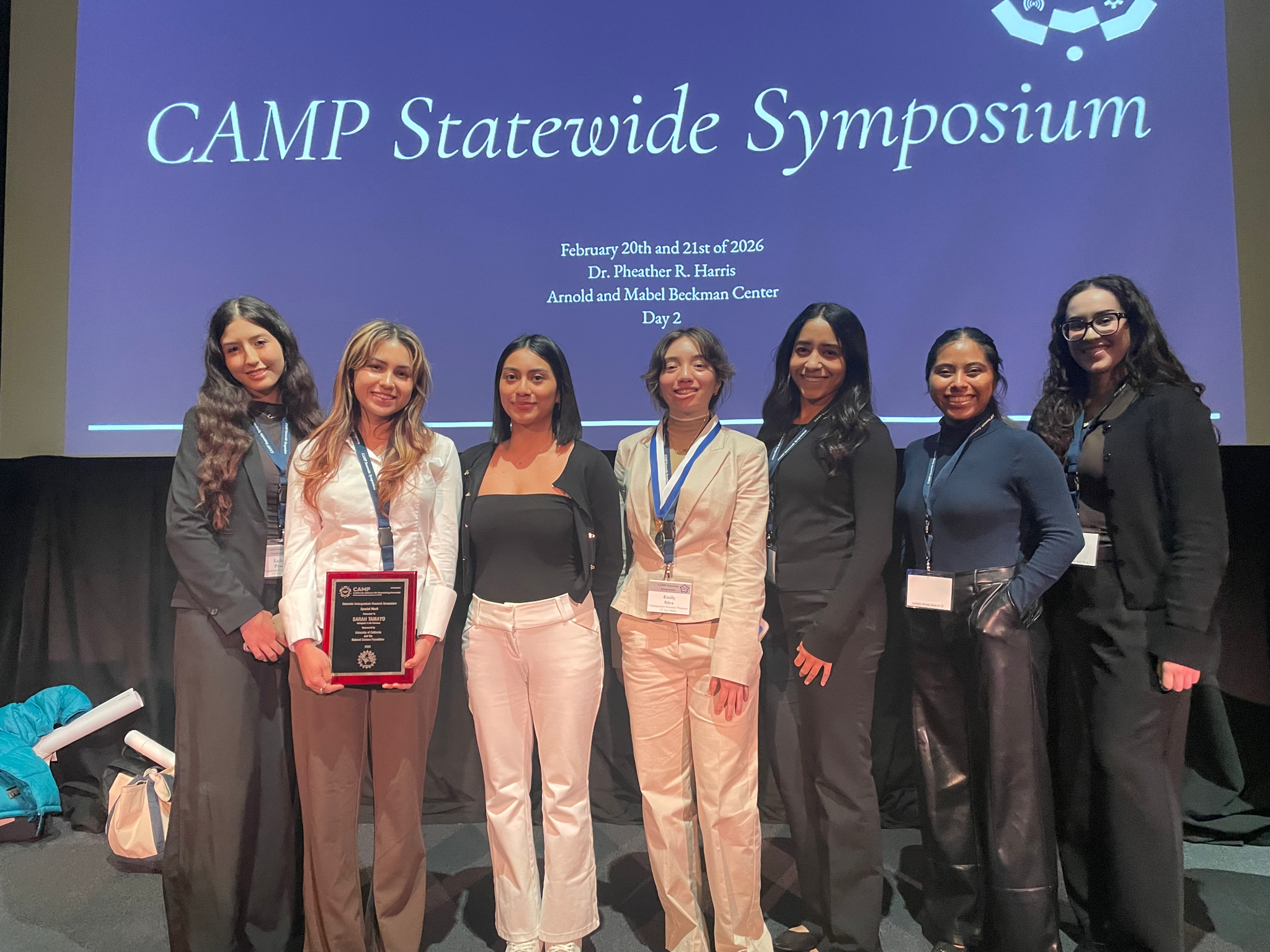
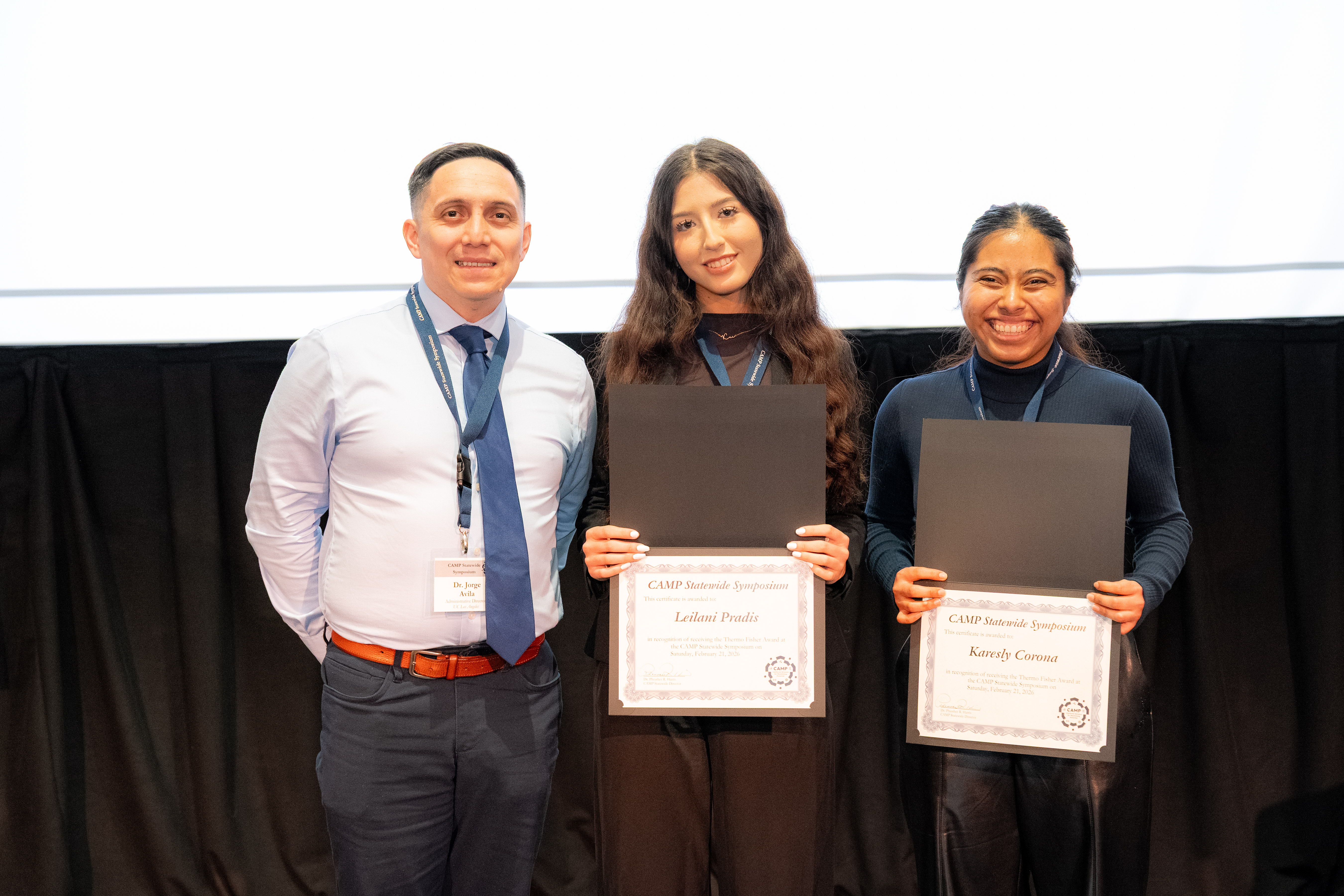
Three UCLA undergraduate student researchers were recognized as awardees at the 2026 Statewide CAMP Symposium. The California Alliance for Maximizing Potential (CAMP) symposium showcases undergraduate STEM research in from all nine UC campuses in the alliance. CAMP is Focused on Advancing Inclusive Excellence in STEM (Science, Technology, Engineering, and Mathematics).
Learn about each awardee’s UCLA research projects and experiences in CAMP, preparation for the symposium, and more that have led them to this moment!
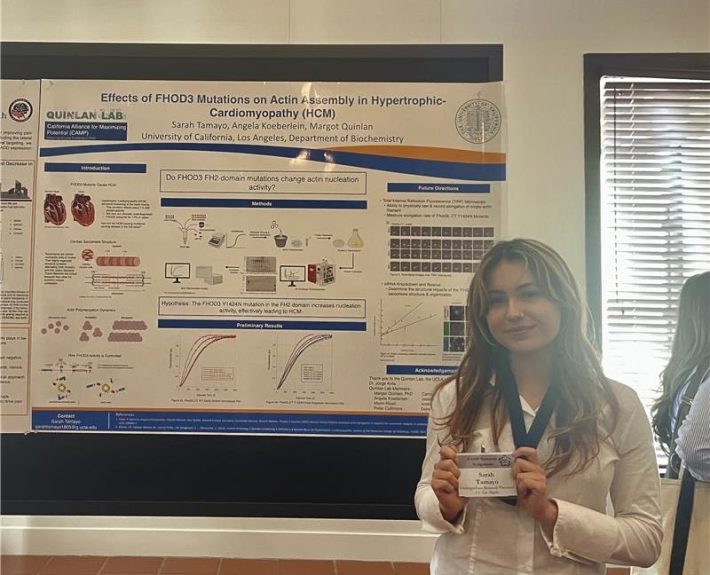
Sarah Tamayo alongside her research poster at the 2026 Statewide CAMP Research Symposium
1. How did you get started in research at UCLA?
I got started in research at UCLA through participating in the PEERS program. This program helped connect me with a graduate student in my lab. After explaining my interests, she helped me secure a spot in my current lab!
2. What inspired you to join your current lab/research group?
I was inspired to join a lab after hearing about so many awesome stories of other undergraduates who were in labs and became deeply passionate about their projects. I specifically sought out my current lab to bridge my interest in cardiology and heart disease with research. I wanted a space where I could design and test my own experiments under the guidance of my mentor and PI.
3. What has been your most impactful research experience in your undergraduate career?
My most impactful research experience was being able to work fulltime in my research lab over the summer. With classes out of the way, I got to fully immerse myself in my research and get to know my labmates better. During this time, I learned so many cool techniques like designing a PCR protocol, conducting ion-exchange chromatography using an AKTA purification system, and testing nucleation activity through actin polymerization assays. Having the time to learn all of these techniques has really helped me become more independent in my lab and see all the planning that goes into a full project.
4. What does research mean to you and your professional aspirations?
My research has truly captivated me and has played a central role in my journey as a UCLA undergraduate. While my career goal is to become a Physician Assistant, the skills I’ve developed in the lab are directly applicable. The troubleshooting, presentation, and collaboration skills I have honed while participating in undergraduate research will always be meaningful to me.
5. What are some of your favorite experiences in CAMP?
My favorite part of CAMP was the sense of community. Beyond the professional development, the weekend of the Statewide Symposium allowed me to form genuine bonds with my peers. Whether we were nervously rehearsing our talks together or celebrating after the presentations, those moments of peer support made this experience all the more rewarding.
6. With the conclusion of the 2026 Statewide CAMP Symposium, we’d love to hear about your preparation process and experience presenting at the symposium. What skills did you gain from these experiences?
When I was preparing my slideshow presentation, I heavily leaned on advice from Dr. Avila, the UCLA CAMP director, that our research should tell the audience a story with a clear message. I focused on building a background that provided enough context for a general audience, and then bringing them back to a bigger picture. I would try to practice my presentation with an audience to overcome my fear of public speaking. Seeing my mentors’ presentation styles in lab meetings also helped me find what presentation style best suited my project.
7. What does being a 2026 Statewide CAMP Symposium awardee mean to you?
I am very happy and grateful to have been selected to receive a 2026 Statewide CAMP Symposium award, but I really want to acknowledge the fact that everyone who participated in CAMP worked extremely hard on their project. Seeing undergraduate projects range from designing insects to reduce pest populations in agricultural regions to testing the efficiency of a novel surgical instrument was actually the my biggest takeaway from this program. It really demonstrated the vastness of undergraduate research and that any curious spark can be transformed into a full-scale research project.
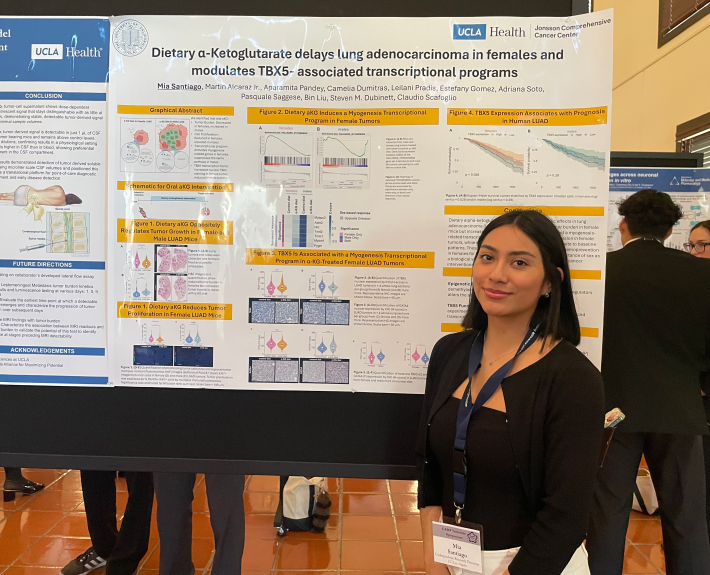
Mia Santiago alongside her research poster at the 2026 Statewide CAMP Symposium
1. How did you get started in research at UCLA?
I got started in research my freshman year at UCLA through the PEERS program. PEERS introduced me to research in the first place through seminars and talks with PIs.
2. What inspired you to join your current lab/research group?
Thanks to outreach from PEERS, I learned about an open position for an undergraduate research assistant in the Scafoglio Lab. Since the summer of 2024, I have been an undergraduate researcher here, where we study lung cancer, specifically lung adenocarcinoma. Throughout the majority of my time in the Scafoglio Lab, I have been assisting my mentor, Martín Alcaraz Jr., with his project investigating the sex-dependent effects of alpha-ketoglutarate on lung adenocarcinoma.
3. What has been your most impactful research experience in your undergraduate career?
The most impactful research experience in my undergraduate career thus far has been contributing as a co-author in a published manuscript. Ever since I joined the Scafoglio Lab, I became dedicated to answering questions one experiment at a time. Not only that, but a volcano of curiosity erupted that led me to dive deeper into the literature and science in order for me to have a better understanding of the work that I conduct. As a result, I became motivated and approached each experiment with eagerness and purpose. Seeing how the collective efforts of my labmates and I contributed to meaningful findings was especially impactful, as it showed me the significance of our research.
4. What does research mean to you and your professional aspirations?
Research means purpose to me. I love science so much, and to be able to actively engage in scientific research allows me to help make discoveries that may help cancer patients. My future career goal is to pursue a PhD. I do not know what exact field I would like to focus on, but I am very interested in cancer, epigenetics, physiology, diet, and the gut microbiome.
5. What are some of your favorite experiences in CAMP?
My favorite experience in CAMP was the 2026 Statewide CAMP Symposium! It was super cool seeing all the posters from everyone in my cohort. It felt like a culmination of the work that we had been working so hard on, which made it bittersweet. Additionally, I got to meet other students from different schools and hear about their research!
6. With the conclusion of the 2026 Statewide CAMP Symposium, we’d love to hear about your preparation process and experience presenting at the symposium. What skills did you gain from these experiences?
Thank you to Dr. Jorge Avila and the seminar he conducted on “Mastering Oral Presentation of Your Research,” I was able to practice presenting my work multiple times. His feedback and the feedback of my peers were so helpful in understanding my strengths and weaknesses. This helped me feel confident and prepared for presenting my work at the symposium to people of varying backgrounds in STEM. Because the symposium was filled with a variety of research fields, I learned how to effectively communicate my research to diverse audiences.
7. What does being a 2026 Statewide CAMP Symposium awardee mean to you?
Being a 2026 Statewide CAMP Symposium awardee means recognition of the work that the Scafoglio Lab has conducted. I have dedicated so much time and energy into our research, and having the opportunity to share our findings and highlight their importance makes it rewarding. It motivates me to work harder and to push myself to help answer more questions.
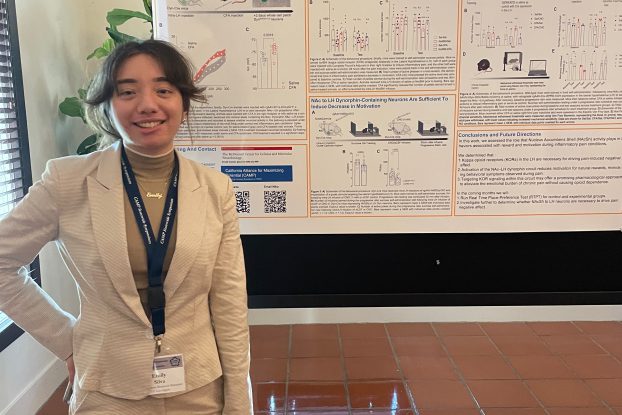
Emily Silva alongside her research poster at the 2026 Statewide CAMP Symposium
1. How did you get started in research at UCLA?
I got started in my second year at UCLA as a sophomore. In my first year, I was part of PEERS, which brought together life science students like me and helped us get ready for research. It introduced basics, such as how to join a lab, especially for people like me who had never been exposed to the field of research. I got started in research my freshman year at UCLA through the PEERS program. PEERS introduced me to research in the first place through seminars and talks with PIs.
2. What inspired you to join your current lab/research group?
I currently conduct research in the Massaly Lab at UCLA. My work focuses on studying the brain’s reward circuitry and how it influences food-seeking behavior in an inflammatory pain model in mice. This research works towards improving pain management therapies for U.S. adults with chronic pain, who are also at higher risk for emotional imbalance and substance use disorders—issues that many current treatments don’t fully address.
3. What has been your most impactful research experience in your undergraduate career?
Doing research at UCLA over the past three years has really shaped my journey. I started out learning basic lab techniques and eventually grew into leading my own projects, asking questions I understand and feel confident exploring. The CAMP program and symposium especially changed how I see research. When you’re in the lab all day, your perspective can feel pretty limited, but CAMP showed me how conferences work and how scientists come together to share ideas. My professors were really supportive, which made the symposium feel much less intimidating compared to larger conferences that involve travel and a lot more funding. That kind of collaboration makes research feel less isolating, especially for younger researchers, even when it gets overwhelming.
4. What does research mean to you and your professional aspirations?
After graduation, I plan to take a gap year to work on applications for Neuroscience PhD programs and continue growing as a researcher. To me, research is both a tool and a way of life—it encourages curiosity about how the world works and helps us explore complex public health issues, from metabolic diseases to learning and memory, through careful study in the lab. Science doesn’t really prove things as “right”; instead, it rules out what is wrong and refines our understanding over time. Everything remains a theory to some extent, and much is still uncertain. Research makes space for mistakes, and that’s exactly how we move forward and make progress.
5. What are some of your favorite experiences in CAMP?
My favorite CAMP experience was speaking at the poster presentations because I got to see, listen to, and learn about the wide range of research happening across the UC system—from agriculture to astronomy to engineering. It reminded me how much there is to explore beyond my own field of neuroscience, and that behind every project are people—peers and researchers—working just as hard as I am to make these research projects a reality.
6. With the conclusion of the 2026 Statewide CAMP Symposium, we’d love to hear about your preparation process and experience presenting at the symposium. What skills did you gain from these experiences?
I really enjoyed talking with professors across the UC system from different departments about my own research beforehand. It pushed me to explain my work in a way that was accessible to people outside of neuroscience, especially in addiction and pain research, while also being able to dive into the technical details with experts in the field. Sharing my research with others is really valuable because I always end up learning something in the process—like what people find confusing or which analogies work best to explain complex ideas.
7. What does being a 2026 Statewide CAMP Symposium awardee mean to you?
It means I’m moving in the right direction in pursuing research! I’m growing from a student who mainly consumes knowledge into a researcher who helps produce it, contributing to discoveries, no matter how small they may be. Not every finding is groundbreaking, but even small steps—like fully understanding a complex cellular mechanism—add important pieces to a larger puzzle. Over time, these pieces help drive bigger advances that improve everyday life, from vaccines and clean food and water to more efficient transportation. Ultimately, solid scientific research plays a role in all of these developments.