
Amit Rand
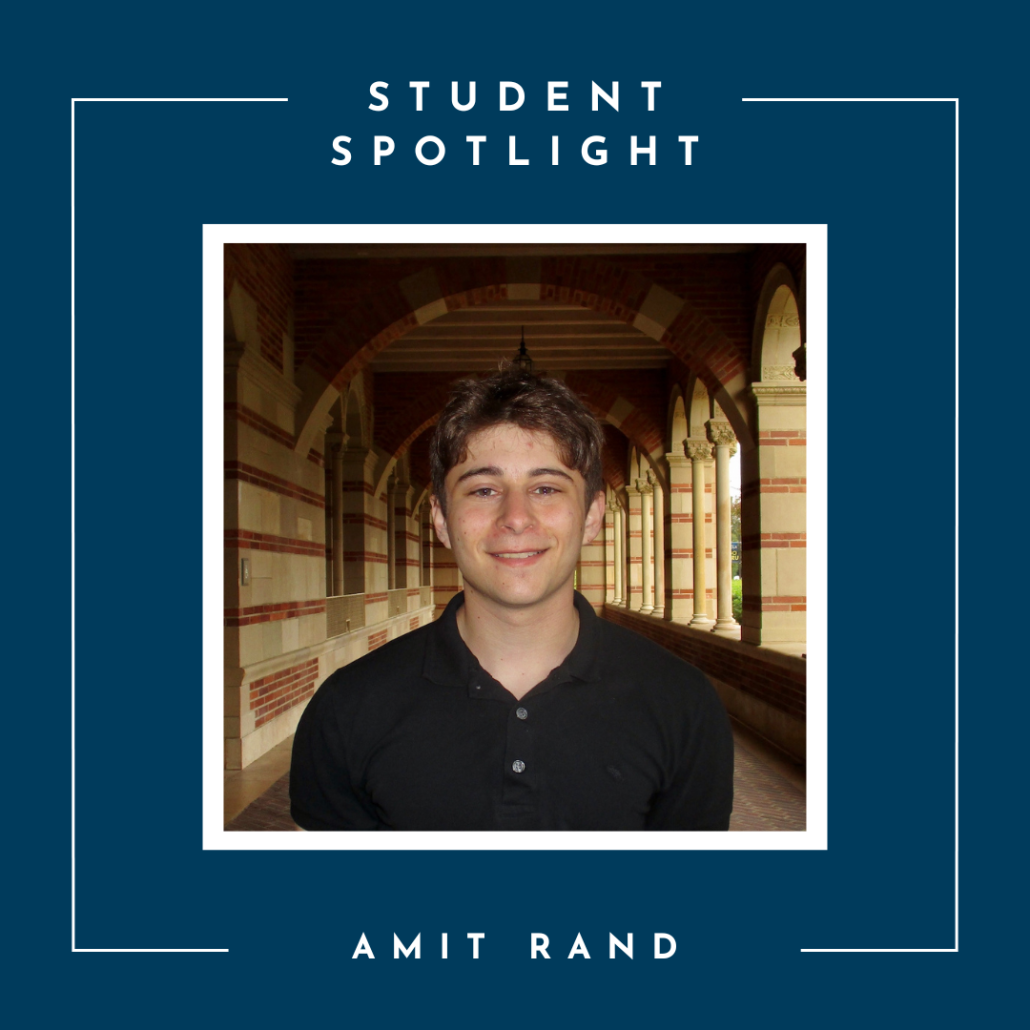
STUDENT SPOTLIGHT
Meet Amit Rand! Amit is a fourth-year Mathematics of Computation major currently conducting research in the Cardiovascular Imaging Research Lab (CVIRL). In addition, Amit was recently accepted into the Undergraduate Research Scholars Program (URSP), a three-quarter scholarship program that supports students who are conducting a life science, physical science, or engineering research project with a UCLA faculty. After completing his PhD, Amit hopes to work at a foundational research lab (industry or academia) focused on cutting-edge mechanistic machine learning, and eventually pursue entrepreneurship. Learn more about Amit and his UCLA research experience below.
1. How did you first get involved in your research project? Tell us a bit about the lab you are in and the research you are conducting (if possible)!
I joined the Cardiovascular Imaging Research Lab (CVIRL) under Prof. Kim-Lien Nguyen and Prof. J. Paul Finn at the David Geffen School of Medicine shortly after transferring to UCLA, and I’ve been in the lab since July 2024. I’m fortunate to be mentored by Dr. Kim-Lien Nguyen and her post-doctoral fellows, Dr. Thomas Coudert and Dr. Mostafa Mahmoudi, and to work with her collaborator, Prof. Dan Ruan, as part of a broader effort to accelerate MRI using machine learning.
A core challenge in MRI is that scans can be time-consuming, which often requires patients to hold their breath to reduce motion and improve image quality. Our long-term goal is to enable free-breathing MRI that improves the patient experience without sacrificing diagnostic fidelity. My work focuses on using generative modeling methods to reconstruct images from faster, more limited measurements. I initially joined the lab through a different project and later transitioned into this direction. Along the way, working closely with postdoctoral scholars and project scientists has been especially formative.
2. How would you describe your research experience at UCLA?
My research experience at UCLA has been incredibly positive and impactful. Through the Student Research Program (SRP), I have been able to dedicate structured, accredited time to research while staying on track academically. In addition to participating in SRP throughout the past year, this quarter I have been able to conduct full-time research through a 12-unit SRP enrollment, which has been especially aligned with my goal of pursuing a PhD. I have also felt strongly supported by mentors across the lab, including faculty, postdocs, and graduate researchers, who consistently make time to teach, give feedback, and help students grow.
Working in a clinical research environment has been uniquely motivating because I can see the real-world importance of the problems we’re solving and how they connect to patient care. I’ve also benefited a lot from URC resources and research-focused seminars, especially sessions that demystify topics like getting started in research and preparing for graduate school.
Additionally, I have felt supported more broadly within UCLA’s academic environment as I have pursued research. I have been fortunate to take multiple graduate-level courses through instructors’ consideration and encouragement, and those experiences have strengthened my technical foundation and clarified the research directions I want to pursue going forward.
3. What is your year and major?
Senior (Class of 2026) and Mathematics of Computation
4. What is one piece of advice you have for other students thinking about getting involved in research? As a transfer student yourself, do you have advice specific to other transfer students?
If you’re even considering research, try it. There’s no “perfect time” to start, and it’s often the best way to discover what you enjoy. Many faculty and labs are genuinely excited to mentor motivated undergraduates, especially when you reach out with a clear interest, willingness to learn, and commitment.
For transfer students specifically, leverage UCLA’s structured programs, especially URC Sciences, early, because they can accelerate your integration into the research community. And if it’s hard to get traction at first, don’t be discouraged. Reach out to postdocs and graduate students, too. They can often offer a smaller, well-scoped project that helps you build confidence, skills, and momentum toward a deeper research role. However, be mindful of postdocs’ and graduate students’ time, and always reach out to the Principal Investigator before starting any project.
5. Have you attended a conference before? If so, can you describe your experience on preparation, presenting, etc.?
I recently attended my first conference, The Thirty-Ninth Annual Conference on Neural Information Processing Systems (NeurIPS), where I presented a workshop paper. It was an amazing experience to be surrounded by experts in the field and to have so many conversations across a wide range of topics.
In preparation, I created my first poster, applied for grants to help cover the cost of attendance and travel, and made sure I could clearly explain my work. For presenting, it helps to have a strong two to five minute overview ready, then be prepared to answer questions and engage in deeper discussion. Most interactions move quickly, but the best conversations are with people working on closely related problems. I was fortunate to speak with teams from Microsoft Research, professors from Cambridge and Emory, and researchers at Toyota Research Institute about parallel ideas and directions.
One piece of advice I would carry forward is to attend the full conference if you can. Being there for the entire week makes a big difference for learning and networking.
6. Have you had your work published? Can you talk about what that process was like?
I have published a peer-reviewed workshop paper at NeurIPS as a co-first author, based on independent research with a peer.
The review process was a valuable first-time experience. I learned how to interpret reviewer feedback, respond thoughtfully to critiques, and iterate on the work to strengthen the final submission. Because NeurIPS workshops are peer reviewed, I was also assigned a few papers to review, which gave me experience seeing the process from the reviewer’s perspective and helped me better understand what makes a submission clear, rigorous, and compelling.
7. What are your future career goals?
After completing my PhD, I hope to work at a foundational research lab (industry or academia) focused on cutting-edge mechanistic machine learning, and eventually pursue entrepreneurship. I believe we are at the start of a major transition, and I want to help build the systems that will shape our world by making them safer, more reliable, while being grounded in the real-world. Longer term, I would also love to return to academia in a teaching-focused role at the university level.
8. Please list any URC/departmental programs you are/were involved in. How has your experience been in these programs?
This year (2025–2026), I have been part of the Undergraduate Research Scholars Program (URSP) Sciences, and I also took the RES PRC 194B graduate school application seminar.
URSP is a scholarship program and provides a strong support system. It supplies resources that make it easier to navigate research and build a clearer path forward to ultimately achieve your goals. One of the most memorable parts was access to the research practices courses (RES PRC).
The graduate school applications seminar with Dr. Hasson was especially helpful. The course is designed to help you build every component of a graduate application end-to-end, then refine it through structured feedback from peers and professors who have either gone through the process or are going through it alongside you.
9. What was the impact of undergraduate research on your career path?
Undergraduate research has been the main reason I am now committed to pursuing a PhD and building a long-term career in research. As a transfer student, my path into research was not straightforward, and community college made it clear how challenging it can be to access both research and industry opportunities. Over the past few years, I completed about five industry internships and three research experiences, which gave me a meaningful basis to compare the two.
While I initially expected to go directly into industry, my research experiences were more fulfilling on an intellectual and technical level, and they gave me a stronger sense of purpose and curiosity in my work. Ultimately, undergraduate research shaped my career direction by helping me realize that I want to contribute by doing deep, long-term research and mentorship in the field.