
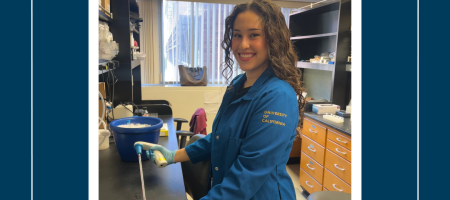
Clarissa Carrillo

STUDENT SPOTLIGHT

Meet Clarissa Carrillo! Clarissa is a fourth-year Biology major looking to pursue a PhD and aspire to conduct research in the field of dermatology to contribute to a better understanding of skin diseases and the development of new treatments. She has been involved in  the Program for Excellence in Education and Research in the Sciences (PEERS), the URC-Sciences Summer Program, and the Louis Stokes California Alliance for Maximizing Potential (CAMP). Clarissa credits undergraduate research to having a significant impact on her career path and has motivated her to pursue graduate school.

1. How did you first get involved in your research project? Tell us a bit about the lab you are in and the research you are conducting!

I was first introduced to research through PEERS and began applying to labs at the end of my sophomore year. I then joined the Mitochondrial Metabolism and Bioenergetics Lab under Dr. Ajit Divakaruni at the beginning of my junior year, where we study how mitochondrial function influences cellular signaling and fate decisions. I spent my first year of research working with my mentor on various projects, but was fortunate enough to start my own project in my lab the following summer through the URC-Sciences Summer Program. My project is ongoing and examines how metabolic pathways shift during neuronal differentiation, particularly through changes in TCA cycle intermediates, using stable isotope tracing and GC-MS analysis.

2. How would you describe your research experience at UCLA?

My research experience at UCLA has been extremely rewarding and eye-opening. It has allowed me to grow as a scientist, gain confidence in my abilities, and learn how to think critically about the questions I’m studying. I’ve also been able to work closely with supportive mentors, develop various technical skills, and contribute to meaningful research. Being a part of such a supportive and collaborative lab has truly made my research experience one of the most fulfilling and memorable parts of my time at UCLA.

3. What is your year and major?

I am a 4th year Biology major.

4. What is one piece of advice you have for other students thinking about getting involved in research?

The biggest piece of advice I can give to students thinking about getting involved in research is to just go for it! Although it can seem daunting at first, it is incredibly rewarding, and your PI and mentor are there to help you learn. When I first started, research seemed intimidating because I wasn’t sure if I would be capable, but my lab quickly became a place where I could grow and gain confidence. It has undoubtedly been the highlight of my undergraduate experience and I encourage anyone thinking of joining a lab to definitely apply!

5. Have you attended a conference before? If so, can you describe your experience on preparation, presenting, etc.?

No, I have not had the opportunity to attend a conference yet. However, I was able to present my summer research project at the Summer SPUR Showcase and will present my current research at the CAMP Statewide Symposium this winter! Preparing for these presentations has taught me how to clearly communicate my work and share my findings with others.

6. Have you had your work published? Can you talk about what that process was like?

Although I have not had my own work published yet, I have been fortunate enough to contribute to a paper that is currently under review. This has given me insight into the detailed and rigorous process of preparing and publishing a manuscript.

7. What are your future career goals?

I plan to pursue a PhD and aspire to conduct research in the field of dermatology to contribute to a better understanding of skin diseases and the development of new treatments. Besides contributing to the scientific field, I hope to share what I have learned with my community. In the long term, I also hope to establish an outreach program for students in the Imperial Valley, where I am from, to introduce them to research and help them navigate pathways in STEM.

8. Please list any URC/departmental programs you are/were involved in. How has your experience been in these programs?

I have been involved in the Program for Excellence in Education and Research in the Sciences (PEERS), the URC-Sciences Summer Program, and the Louis Stokes California Alliance for Maximizing Potential (CAMP). All of these programs have been very meaningful to me and have provided me with invaluable experiences. PEERS first introduced me to the path of research, and the URC-Sciences Summer Program and CAMP taught me how to develop my independence as a researcher, communicate my work effectively, and learn more about graduate school.

9. What was the impact of undergraduate research on your career path?

Participating in undergraduate research has had a significant impact on my career path. Before joining a lab, I was unsure of what I wanted to pursue after undergrad, but research helped me realize how much I enjoy asking scientific questions and contributing to new knowledge. My experience in undergrad has motivated me to pursue graduate school and continue doing research at a deeper level. While I am still exploring the exact direction I want to take, I am especially interested in research in the field of dermatology to better understand skin diseases through metabolism, immunology, and cell fate pathways.
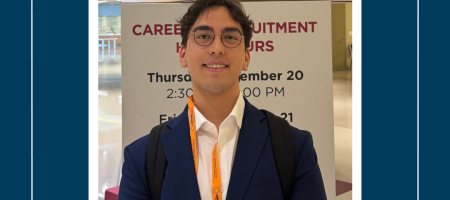
Christian Aguirre

STUDENT SPOTLIGHT

Meet Christian Aguirre! Christian is a fourth-year MIMG major, and recently presented at the ABRCMS Conference, hosted by the American Society for Microbiology. As of Fall 2025, Christian was accepted into the Undergraduate Research Fellows Program (URSP), a three-quarter scholarship program that supports students who are conducting a life science, physical science, or engineering research project with a UCLA faculty. Christian hopes to become a physician-scientist in the future and credits undergraduate research for strengthening his desire to pursue this career.

1. How did you first get involved in your research project?

Tell us a bit about the lab you are in and the research you are conducting (if possible)! I transferred to UCLA from community college without any research experience. I started cold-emailing faculty to find research opportunities on campus. I eventually interviewed with the Pernas lab after reading about their research focus: host–pathogen interactions and metabolism during infection by the intracellular protozoan parasite Toxoplasma gondii . I joined the lab in October 2024 and started to learn relevant lab skills from the get-go. I conveyed interest in pursuing an independent research project to my mentor. This led me to pursuing MIMG Path 2, the major’s advanced independent research capstone project. My research project focuses on how the protein glutathione peroxidase 4 (GPX4) affects parasite growth. GPX4 is a key protein for protecting our cells from the accumulation of lipid peroxides, a potentially harmful lipid species that can lead to a form of non-apoptotic cell death known as ferroptosis. However, the role of GPX4 in T. gondii growth remains unclear. My work fits into a much larger project under my mentor, which further explores the role of lipids in T. gondii infection.

2. How would you describe your research experience at UCLA?

Enriching, fun, and a once-in-a-lifetime opportunity! I knew I loved science and being in a non–research lab environment from my lab classes, but I was unsure how I would like research itself. Now, I can say that my research experience at UCLA over the past year has been one of the most rewarding experiences in terms of the supplemental opportunities I have been able to pursue. Our lab is definitely a family environment and very supportive of one another, and I’m beyond grateful to be part of it!

3. What is your year and major?

I am a fourth year microbiology, immunology, and molecular genetics major.

4. What is one piece of advice you have for other students thinking about getting involved in research?

Be confident in yourself. It sounds cliché, but, speaking from experience, it’s very easy to feel the effects of imposter syndrome. When starting, you might feel like you need to know everything about the science that your lab is investigating. The truth is that you aren’t expected to. From what I’ve learned, research is an environment of academic growth and personal development, especially during your undergrad. As long as you are confident in your abilities and show interest in your work, you’ll do great!

5. How was your experience presenting at the American Society for Microbiology’s conference? Feel free to walk us through your preparation, day to day at the conference, things you’ve learned, etc.

It was amazing! I’ve attended conferences before, but not as a presenter. This time around, I had the opportunity to present my project in the form of an oral presentation. The ABRCMS conference, hosted by the American Society for Microbiology, was definitely a great step into scientific presentation. The environment was incredibly supportive and developmental for undergraduate students, post-baccalaureate, and graduate students alike – I felt very welcomed during my participation. In preparation for the conference, I practiced my presentation with my lab for their feedback, met with my mentor to polish my slides, and read publications to prepare myself for potential questions. At the conference, you are given a comprehensive itinerary in which you can choose what events to attend (some events overlap, so you are encouraged to network with others to get the most out of the conference!). I attended panel discussions related to post-baccalaureate programs, navigating the current scientific landscape, expert lectures on several biomedical research fields, how to prepare for an MD/PhD, student poster and oral presentations, and a career development and recruitment hall (where you can meet program representatives to ask questions and network with them). Overall, I learned a lot about the options that are available after completing your undergraduate degree, received so much advice from experienced scientists, and made tons of connections!

6. What are your future career goals?

I would like to pursue the journey of becoming a physician-scientist. I enjoy the lab environment and research so much, as well as the direct patient interaction that comes from working in healthcare – I cannot see myself pursuing a career that does not cohesively bridge the realms of scientific research and patient care.

7. Please list any URC/departmental programs you are/were involved in. How has your experience been in these programs?

In the spring of 2025, I was accepted into the MIMG Path 2 (Advanced Independent Research) program, in which I continued my research project that I had started under an SRP 199 contract. Then, in the fall of 2025, I was accepted into the URC Undergraduate Research Scholars Program. These opportunities have been developmental in terms of my experience in and exposure to the vast world of scientific research. Having the opportunity to continue my research with additional funding and grow my scientific knowledge and communication skills as a researcher has been one of the most fulfilling experiences of my academic and professional journey thus far. I believe that both of these programs have prepared me for my next steps forward in science.

8. What was the impact of undergraduate research on your career path?

I knew that I wanted to pursue a career in the medical field and had considered the physician-scientist path. Undergraduate research has only strengthened my desire to follow this career and has given me better insight into my research interests and strengths.