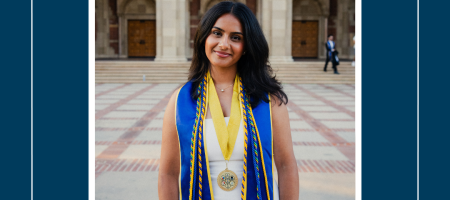
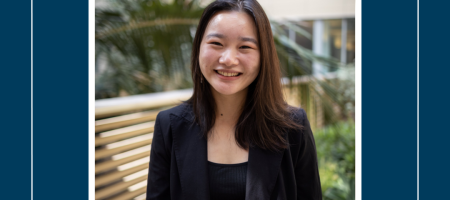
Meet Priscilla Yang! Priscilla is a recent UCLA graduate who received her B.S. in Bioengineering with a minor in Geography/Environmental Studies. She was involved in the Undergraduate Research Fellows Program (URFP) during the 2022-2023 academic year, a two-quarter program that supports UCLA students who are conducting a life science, physical science, or engineering research project with a UCLA faculty. Additionally, Priscilla was a 2023-2024 Internet Research Initiative Scholar (IRI), a program that supports research that addresses aspects of technology development, social trends or problems, ethics, and/or justice relating to the Internet. One piece of advice Priscilla has for undergraduate students thinking about getting involved in research is to “…prioritize good mentors — look for labs and professors who build uplifting learning environments and have a teaching style that works well for you! (I.e. Are you hoping to work 1-on-1 with a graduate student who is very hands-on? How often do you hope to talk with your professor about your research?).”
1. How did you first get involved in your research project?
I first got involved with my environmental engineering research after learning about my TA’s PhD research during class. I was excited about the impacts of such research, so I reached out, set up a meeting, and slowly got trained in the lab over the next couple of months!
2. How would you describe your research experience at UCLA?
I’ve had a very transformative and exploratory research experience at UCLA! I had the opportunity to join a variety of research projects: environmental engineering research at a formal UCLA lab regarding microbial technology for contaminant cleanup and wastewater treatment systems; co-leading a student-run research group as part of the Biomedical Engineering Society’s Research Team surrounding hydrogels for insulin delivery; and an individual creative research project through the Internet Research Initiative exploring music as a communication medium in healthcare. Through all of these, I found the fun in hands-on learning through experiments, critical thinking in experimental design and data analysis, and an overall passion for maneuvering between various scientific fields by using fundamental principles. Research at UCLA was also a key driver in my graduate school pursuits!
3. What is your year and major?
I just graduated in Spring 2024 with a B.S. in Bioengineering and a minor in Geography/Environmental Studies.
4. What is one piece of advice you have for other students thinking about getting involved in research?
My biggest piece of advice for students thinking about getting involved in research is to prioritize good mentors — look for labs and professors who build uplifting learning environments and have a teaching style that works well for you! (I.e. Are you hoping to work 1-on-1 with a graduate student who is very hands-on? How often do you hope to talk with your professor about your research?)
5. Have you attended a conference before? If so, can you describe your experience on preparation, presenting, etc.?
I had the opportunity to attend the BMES (Biomedical Engineering Society) Annual Meeting 2023 in Seattle during the fall! It was an enriching experience overall- my main reason for attendance was to present a poster about my research project within the Internet Research Initiative. Leading up to the conference, I worked to finalize my poster design, as well as draft, edit, and practice my pitch talk over and over. During the actual presentation, it was a lively atmosphere of students ranging from undergraduate to postdoctoral levels. Typically, the flow of events occurred with passerbys being interested in my poster title, me presenting my pitch talk, and them interacting and asking questions afterward. I even got to network on LinkedIn with fellow students as well!
Beyond presenting my poster, an unexpected yet useful experience I had at the conference was interacting with graduate school representatives at their booths. Since this was around the time where graduate school applications were being submitted, I was able to talk to current students at the programs I was looking at, along with admissions officers who provided application tips. Even better, a few schools offered application fee waivers just for your attendance! Beyond academic work, I was a volunteer for both the national BMES organization and the UCLA department of Bioengineering. Thus, I got to meet a variety of like-minded bioengineering students; moderate and learn about cutting-edge research panels; and share my personal experiences at UCLA bioengineering with prospective students! Overall, it was a worthwhile experience, and I’d encourage interested students to look into funding resources (Undergraduate Research Center fund, Academic Affairs Commission Travel Fund, etc) to help mitigate costs and make travel more accessible.
6. Have you had your work published? Can you talk about what that process was like?
I have not had my work published.
7. What are your future career goals?
I will be pursuing a master’s in Biomedical Engineering and a graduate minor in Entrepreneurship at Northwestern University this fall! Beyond that, I aspire to gain industry experience in the biotechnology space and potentially pursue a PhD and MBA in the future.
8. Please list any URC/departmental programs you are/were involved in.
Undergraduate Research Fellowship Program (URFP) – 2022-2023
Internet Research Initiative Scholar – 2023-2024
9. What was the impact of undergraduate research on your career path?
Undergraduate research at UCLA played a pivotal role in my pursuit for graduate school in my career path. The creativity, critical thinking, collaborative, and communication skills that I developed through research have been instrumental in my career path, carrying me beyond the lab bench and into industry roles!